2025-12-20
How Laser Cutting Machines Collaborate Perfectly with Robots and Material Warehouses?
(Click 298 )In the intelligent transformation of modern manufacturing, the automated integration of laser cutting machines with robots and material warehouses is becoming a core solution for improving production efficiency. The perfect collaboration of these three elements breaks the isolated model of traditional processing, building an integrated intelligent production closed loop of “material handling – cutting – warehousing.”
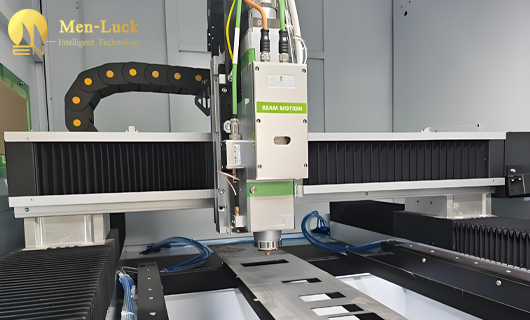
The core of this collaboration lies in the precise synchronization of information exchange. Through the industrial internet platform, the laser cutting machine transmits real-time processing requirements (such as sheet material, cutting graphics, and processing sequence) to the central control system, which then issues instructions to the robot and material warehouse. The material warehouse automatically retrieves raw materials of the corresponding specifications according to the requirements, and the sheets are transported to the robot’s working area via a rail-mounted conveyor belt. The entire process requires no manual intervention, and the response time can be shortened to seconds.
The robot, as the “execution hub” of the collaboration, achieves millimeter-level operating precision with high-precision sensors and servo motors. During material handling, the robot uses visual recognition to locate the sheet position and flexibly adjusts the gripping angle to avoid scratching the sheet; during the cutting process, it tracks the laser head’s movement trajectory in real time and simultaneously adjusts the sheet’s posture to ensure cutting accuracy; after processing, the robot can quickly classify and transfer the finished products to the designated storage location in the material warehouse, or directly transfer them to the next process, achieving “seamless connection.”
The material warehouse acts as an “intelligent warehousing manager.” Its multi-tiered shelving design significantly saves space, and with the help of handling robots, it can achieve automatic inbound and outbound handling of raw materials and finished products. At the same time, the warehouse system updates inventory data in real time, and when the inventory of a certain raw material is insufficient, it automatically triggers a replenishment reminder to avoid production interruptions. For example, a certain automotive parts factory has increased the per capita efficiency of its laser cutting production line by 3 times, reduced the raw material loss rate to 1.2%, and shortened the production cycle by 40% through this integrated solution.
This automated integration model not only solves the pain points of high labor costs, low efficiency, and poor accuracy in traditional processing, but also gives the production line flexible production capabilities, allowing for rapid switching between different product processing procedures, laying a solid foundation for the manufacturing industry to move towards “lights-out factories.”
 WhatsApp:
 Wechat
Advantages of laser cutting nickel-titanium electrode 2024-05-06
In recent years, with the continuous development of medical technology, medical laser cutting machines play an important role in the manufacture of nickel-titanium electrode sheets. Next, we will introduce the application and advantages of our Men-luck laser cutting machine in t…
Laser cutting process of eye lens 2024-04-11
With the increasing demand for vision correction in modern society, glasses, as a common optical instrument for vision correction, play an indispensable role in People's Daily life. Lens processing is a delicate process that requires cutting and punching to complete the manufact…
Ultrafast femtosecond laser technology helps cardiovascular stent manufacturing 2024-04-08
With the soaring incidence of cardiovascular and cerebrovascular diseases, stent implantation has become one of the main methods of surgical treatment. Compared with traditional cutting equipment, medical laser cutting machine not only has good cutting quality, high cutting prec…
Application of laser cutting machine in mobile phone camera module manufacturing 2024-04-04
With the continuous progress of science and technology and the improvement of people's requirements for quality of life, the fields of smart wear, smart home, automotive electronics and mobile phone consumer electronics have been vigorously developed. In these fields, the camera…