2025-07-15
Laser cutting machine reshapes single crystal germanium precision manufacturing
(Click 337 )In the infrared night vision device that penetrates the night sky, and behind the satellite’s lens that gazes at the earth, single crystal germanium has become the core material of high-end optics with its excellent infrared transmittance. However, the processing of this brittle crystal was once a huge challenge – the edge collapse, microcracks and lattice damage caused by traditional mechanical cutting seriously restricted the performance of the device. The emergence of laser cutting technology, like a precise “light knife”, has opened up a new era for single crystal germanium processing.
Single crystal germanium has an irreplaceable excellent transmittance to 8-14 micron infrared light, but the stress of mechanical cutting can cause edge collapse, subsurface microcracks and lattice damage, especially for thin slice processing. Laser cutting completely avoids mechanical stress with a non-contact “light blade”, and the CO2 laser cutting machine with a wavelength of 10.6 microns forms a natural energy match with the germanium material. By precisely modulating the pulse energy and action time, the laser instantly vaporizes the material at the microsecond level, controls the heat-affected zone at the micron level, and with the help of inert gas blowing, achieves a mirror-like cut surface, and the edge quality directly meets the requirements of optical assembly.
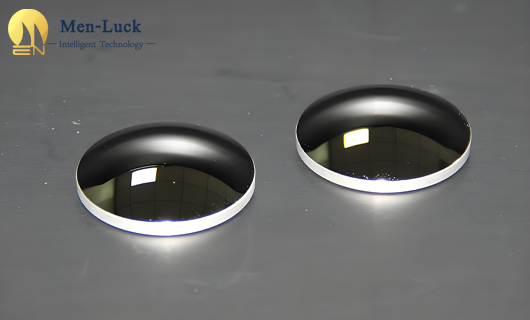
This technology not only breaks through the processing bottleneck, but also liberates the design freedom. Whether it is a special-shaped hole or a complex curved surface, the laser can accurately control it, and the motion control accuracy of ±3 microns makes the cutting trajectory as precise as a pen tip. Its value is particularly prominent in the high-end field: the infrared lens blanks provided for thermal imagers have smooth cuts to ensure high transmittance; the processed satellite sensor windows have intact lattices that can withstand extreme temperature differences in space; the undamaged edges of high-purity germanium gamma-ray detectors ensure the accuracy of signal acquisition; the flat interface of the high-power laser germanium heat dissipation substrate significantly improves the heat dissipation efficiency.
When the laser beam lightly passes over the surface of the germanium sheet, it leaves behind a geometrically precise outline, which is also a perfect protection of the material properties. This “light chisel” achieves the unity of precision and integrity in brittle crystal processing with its ultimate thermal control and contactless processing philosophy, allowing the infrared optical potential of single crystal germanium to be fully released and laying a solid foundation for human exploration of the invisible infrared world.
 WhatsApp:
 Wechat
Selecting Laser Cutting Machine Configurations Based on Application 2026-11-12
Different processing applications impose distinct requirements on fiber laser cutting machines. A reliable approach to equipment selection is to first analyze the workpieces, then evaluate the technical specifications. For thin-sheet batch components—such as enclosures o…
Key points for selecting fiber laser cutting machine for cutting thick carbon steel plates 2026-10-21
The cutting of thick carbon steel plates is a key concern for many equipment supervisors in metal processing plants. Traditional plasma cutting has a rough cross-section and requires a large amount of subsequent processing; The performance of fiber laser cutting machines in the…
Fiber Laser Cutting Machine: Addressing Stainless Steel Slag Adhesion 2026-09-29
In stainless steel cutting, slag hanging and burrs are common issues in sheet metal workshops, which not only increase grinding time but also affect workpiece accuracy and delivery efficiency. As a laser cutting machine manufacturer, we share several practical suggestions from …
Laser precision cutting machine: the core equipment for semiconductor and communication device manufacturing 2026-08-17
In the field of semiconductor and communication device manufacturing, the limits of accuracy are constantly being rewritten - chip processes are approaching physical limits, 5G base station filter apertures continue to shrink, and tolerances for some key features have entered t…