2025-06-09
Is laser cutting faster than CNC cutting?
(Click 297 )In the manufacturing industry, the efficiency of cutting technology directly affects the production cycle and cost. As mainstream metal processing methods, the speed comparison between laser cutting and CNC cutting (such as plasma cutting) has always been the focus of industry attention. This article will combine the latest technical parameters and actual cases to deeply explore the speed difference and applicable scenarios between the two.
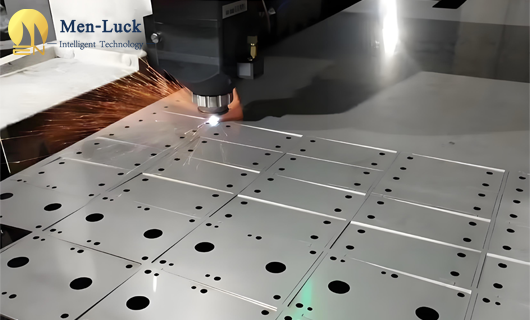
Laser cutting machine uses a high-energy-density laser beam to instantly melt or vaporize the material, and cooperates with airflow slag removal to achieve cutting. Its core advantages lie in high precision and high speed, especially in the field of thin plates. For example, the laser cutting speed of 1mm stainless steel plate can reach 15-20m/min, which is more than 50% faster than plasma cutting. CNC plasma cutting melts the material through a high-temperature plasma arc. Although the cutting speed is slightly inferior to that of laser, it still has unique advantages in thick plate processing.
From the basic data, the upper limit of laser cutting speed is significantly higher than that of plasma. Taking 2mm low-carbon steel as an example, the cutting speed of 1200W laser can reach 600cm/min (ie 6m/min), while the speed of plasma cutting 20mm thick plate is about 1500mm/min (ie 1.5m/min). This shows that in the thin plate scenario, the speed advantage of laser cutting is extremely obvious.
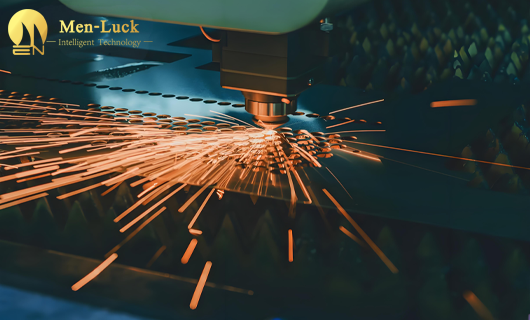
Laser cutting has significant speed advantages in thin plate, high precision, and high value-added scenarios, especially for conventional materials such as stainless steel and carbon steel. CNC plasma cutting is more cost-effective in thick plate, high reflectivity materials and low-cost demand scenarios. With the development of high-power laser technology, its speed in the thick plate field has approached or even surpassed plasma, and its application range will be further expanded in the future.
When choosing cutting technology, enterprises need to comprehensively consider material type, thickness, precision requirements and long-term costs to achieve the optimal balance between efficiency and economy.
 WhatsApp:
 Wechat
Laser precision cutting machine: the core equipment for semiconductor and communication device manufacturing 2026-08-17
In the field of semiconductor and communication device manufacturing, the limits of accuracy are constantly being rewritten - chip processes are approaching physical limits, 5G base station filter apertures continue to shrink, and tolerances for some key features have entered t…
Metal Laser Cutting Machines for Precision Airbag Generator Components 2026-07-17
In automotive passive safety systems, the airbag generator is a propellant-driven precision device. It contains multiple thin-walled metal components, such as the igniter housing, filter support, and gas diffuser. These components need to withstand extremely high temperatures a…
Laser Cutting Machines: An Efficiency Revolution for Construction Sites and Factory Maintenance 2026-06-26
In construction installation, equipment rental, and factory maintenance, do you often encounter this dilemma: urgently needing a steel beam of a specific size, an irregularly shaped reinforcing plate, or a non-standard flange gasket? Outsourcing processing has long cycles, and …
Femtosecond Laser Precision Cutting: Overcoming the Challenges of Processing Nickel-Titanium Heart Stents 2026-05-19
In the field of interventional cardiology, heart stents are hailed as the "guardians of life's pathways." A nickel-titanium alloy tube—measuring a mere 1.5 millimeters in diameter with a wall thickness of approximately 100 microns—must be processed into a mesh-like structure fe…