2025-05-10
Innovative application of laser cutting machine processing of coated paper
(Click 339 )Due to its high gloss, printability and crisp texture, coated paper is widely used in high-end packaging, art paper products and cultural and creative products. The traditional die-cutting process has limitations such as high mold cost and poor flexibility. Laser cutting technology, with its non-contact and high-precision advantages, has opened up a new path of precision and personalization for coated paper processing, and promoted the upgrading of paper product design to creativity and efficiency.
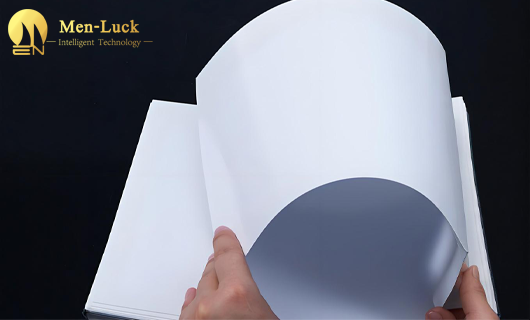
Through micron-level spot (0.1-0.3mm) and intelligent path planning, laser cutting can achieve precise processing of complex patterns, micro-hole arrays or special-shaped hollows on the surface of coated paper, and the cuts are smooth and without burrs. For example, the gold-stamped embossed pattern of the luxury packaging box is achieved by laser pre-cutting the coated paper base layer and then compounding the gold foil material to achieve a three-dimensional light and shadow effect. The process accuracy is 50% higher than that of traditional knife molds, and there is no need for mold opening costs.
For multi-layer coated paper stacking structures (such as hardcover book covers), laser cutting can simultaneously complete shape cutting and partial semi-penetrating notching, and use the hot-melt characteristics of paper to achieve glue-free lamination. By adjusting the laser power and focus position, a depth-controlled “invisible fold line” is formed on 300g/m² coated paper to ensure that there is no breakage or white mark at the bend, improving the durability and aesthetics of the product.
Ultraviolet laser can perform micron-level etching on the coated surface of coated paper to form invisible codes or anti-counterfeiting textures that are invisible to the naked eye, and combine with UV ink printing to achieve double anti-counterfeiting. For example, a limited edition art album uses a laser to engrave a unique serial number on the cover page of coated paper to enhance its collection value.

Laser cutting does not require a physical mold, reducing 90% of the knife mold development cost, and is particularly suitable for small batch orders. By optimizing the cutting path through nested typesetting software, the utilization rate of coated paper is increased by 20%-30%, and the loss of scraps is significantly reduced. After a packaging company introduced laser equipment, its overall production costs dropped by 35%. At the same time, it achieved a pollution-free combination of water-based ink and laser technology and passed the FSC forest certification.
 WhatsApp:
 Wechat
Selecting Laser Cutting Machine Configurations Based on Application 2026-11-12
Different processing applications impose distinct requirements on fiber laser cutting machines. A reliable approach to equipment selection is to first analyze the workpieces, then evaluate the technical specifications. For thin-sheet batch components—such as enclosures o…
Key points for selecting fiber laser cutting machine for cutting thick carbon steel plates 2026-10-21
The cutting of thick carbon steel plates is a key concern for many equipment supervisors in metal processing plants. Traditional plasma cutting has a rough cross-section and requires a large amount of subsequent processing; The performance of fiber laser cutting machines in the…
Fiber Laser Cutting Machine: Addressing Stainless Steel Slag Adhesion 2026-09-29
In stainless steel cutting, slag hanging and burrs are common issues in sheet metal workshops, which not only increase grinding time but also affect workpiece accuracy and delivery efficiency. As a laser cutting machine manufacturer, we share several practical suggestions from …
Laser precision cutting machine: the core equipment for semiconductor and communication device manufacturing 2026-08-17
In the field of semiconductor and communication device manufacturing, the limits of accuracy are constantly being rewritten - chip processes are approaching physical limits, 5G base station filter apertures continue to shrink, and tolerances for some key features have entered t…