2025-07-02
Application of laser cutting machines in different fields of precision structural parts
(Click 268 )Electronic information field
In the electronic information industry, the size of precision structural parts is getting smaller and smaller, but the precision requirements are getting higher and higher. Laser cutting machines play a key role in the processing of printed circuit boards (PCBs), connectors, sensors and other structural parts.
In PCB processing, laser cutting can achieve high-precision micro-hole processing and line cutting, and can cut lines with a width of only tens of microns, effectively improving the integration and performance of circuit boards. At the same time, for the cutting of flexible circuit boards (FPCs), laser cutting machines can avoid edge burrs, deformation and other problems caused by traditional mechanical cutting, and ensure the quality and reliability of circuit boards. In the processing of connectors and sensor structural parts, laser cutting can accurately process complex shapes and tiny holes to meet the development trend of miniaturization and precision of electronic components.
Aerospace field
The aerospace field has extremely stringent requirements on the quality and performance of precision structural parts. Laser cutting machines are widely used in the processing of aircraft engine blades, aircraft skins, satellite parts, etc. The shape of aircraft engine blades is complex, and high requirements are required for high temperature resistance and corrosion resistance. Laser cutting machines can cut complex cooling channels while ensuring blade accuracy, thereby improving the heat dissipation performance and service life of blades.
For aircraft skins, laser cutting can achieve stress-free cutting, avoid stress concentration problems caused by traditional cutting methods, and improve the strength and reliability of the skins. In satellite parts processing, laser cutting can process high-precision mirror brackets and other structural parts to ensure the optical performance and working stability of satellites.
Medical device field
The precision structural parts in medical devices are directly related to the life, health and treatment effects of patients, and have extremely high requirements for processing accuracy and biocompatibility. Laser cutting machines have unique advantages in the processing of structural parts such as surgical instruments and implantable medical devices.
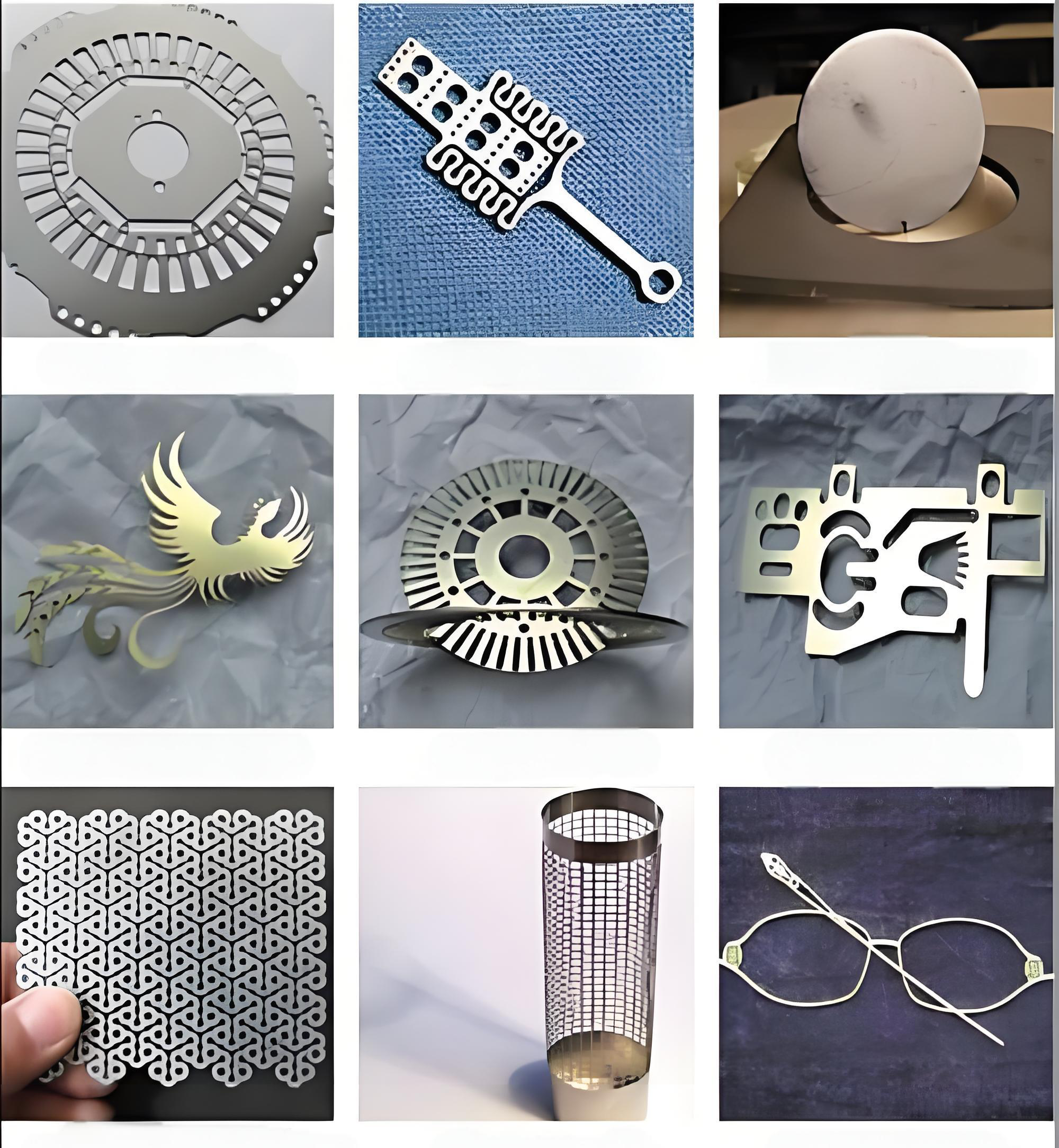
In the processing of surgical instruments, such as precision surgical blades and vascular stents, laser cutting can process extremely sharp blades and complex mesh structures to improve the operating performance and treatment effects of surgical instruments. For implantable medical devices, such as artificial joints and pacemaker housings, laser cutting can not only ensure the high precision and complex shapes of structural parts, but also optimize the surface quality of materials by controlling cutting parameters, improve their biocompatibility, and reduce human body rejection reactions.
 WhatsApp:
 Wechat
Laser precision cutting machine: the core equipment for semiconductor and communication device manufacturing 2026-08-17
In the field of semiconductor and communication device manufacturing, the limits of accuracy are constantly being rewritten - chip processes are approaching physical limits, 5G base station filter apertures continue to shrink, and tolerances for some key features have entered t…
Metal Laser Cutting Machines for Precision Airbag Generator Components 2026-07-17
In automotive passive safety systems, the airbag generator is a propellant-driven precision device. It contains multiple thin-walled metal components, such as the igniter housing, filter support, and gas diffuser. These components need to withstand extremely high temperatures a…
Laser Cutting Machines: An Efficiency Revolution for Construction Sites and Factory Maintenance 2026-06-26
In construction installation, equipment rental, and factory maintenance, do you often encounter this dilemma: urgently needing a steel beam of a specific size, an irregularly shaped reinforcing plate, or a non-standard flange gasket? Outsourcing processing has long cycles, and …
Femtosecond Laser Precision Cutting: Overcoming the Challenges of Processing Nickel-Titanium Heart Stents 2026-05-19
In the field of interventional cardiology, heart stents are hailed as the "guardians of life's pathways." A nickel-titanium alloy tube—measuring a mere 1.5 millimeters in diameter with a wall thickness of approximately 100 microns—must be processed into a mesh-like structure fe…