2025-10-10
Laser Cutting: The “Precision Tailor” Reshaping the Sheet Metal Fabrication Industry
(Click 293 )In the tide of modern manufacturing, sheet metal fabrication is a fundamental and critical process, and its technological level directly determines product quality and efficiency. Among numerous processing techniques, laser cutting, with its unparalleled advantages, has undeniably become the core and soul of the sheet metal fabrication industry, revolutionizing traditional processing methods.
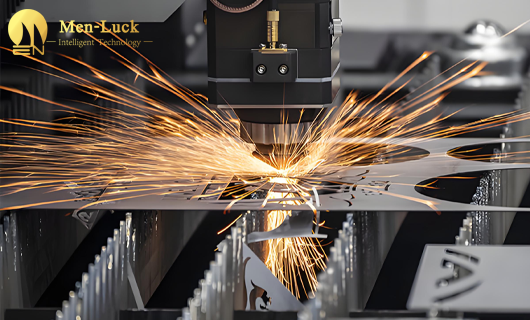
With its exceptional precision and flexibility, laser cutting has revolutionized “mold-free” production. Traditional stamping relies on molds, resulting in high costs and long cycles, making it suitable only for high-volume, fixed-pattern production. Laser cutting, driven by a CNC system, can instantly focus a high-energy laser beam on the metal surface, achieving precise melting and vaporization. Whether creating complex contours, tiny holes, or intricate text patterns, simply design the drawing on a computer and start processing quickly. This “flexible processing” perfectly meets the current market demand for small batches, high variety, and rapid iteration, significantly enhancing companies’ responsiveness.
Laser cutting’s superior processing quality and wide material compatibility expand the boundaries of design. Laser cutting produces smooth, burr-free cuts, minimizes heat-affected zones, and minimizes deformation. A single process produces high-quality, near-finished workpieces, significantly reducing subsequent secondary processing steps such as polishing and reshaping. Furthermore, it can efficiently process not only common metals like carbon steel and stainless steel, but also aluminum alloys, brass, titanium alloys, and even some non-metallic materials. This allows designers to more boldly utilize a variety of materials and complex structures, transforming their wildest ideas into real products.
The automation and high efficiency of laser cutting are key drivers of industrial upgrading. Combined with automated loading and unloading systems (automated material storage), laser cutting equipment can operate 24/7. From sheet loading and intelligent layout to cutting and unloading, the entire process is unmanned, maximizing production efficiency while optimizing material utilization, reducing labor costs and human errors, and laying a solid foundation for the realization of “smart factories” and “dark workshops.”
 WhatsApp:
 Wechat
Selecting Laser Cutting Machine Configurations Based on Application 2026-11-12
Different processing applications impose distinct requirements on fiber laser cutting machines. A reliable approach to equipment selection is to first analyze the workpieces, then evaluate the technical specifications. For thin-sheet batch components—such as enclosures o…
Key points for selecting fiber laser cutting machine for cutting thick carbon steel plates 2026-10-21
The cutting of thick carbon steel plates is a key concern for many equipment supervisors in metal processing plants. Traditional plasma cutting has a rough cross-section and requires a large amount of subsequent processing; The performance of fiber laser cutting machines in the…
Fiber Laser Cutting Machine: Addressing Stainless Steel Slag Adhesion 2026-09-29
In stainless steel cutting, slag hanging and burrs are common issues in sheet metal workshops, which not only increase grinding time but also affect workpiece accuracy and delivery efficiency. As a laser cutting machine manufacturer, we share several practical suggestions from …
Laser precision cutting machine: the core equipment for semiconductor and communication device manufacturing 2026-08-17
In the field of semiconductor and communication device manufacturing, the limits of accuracy are constantly being rewritten - chip processes are approaching physical limits, 5G base station filter apertures continue to shrink, and tolerances for some key features have entered t…