2025-04-24
Laser cutting machine manufactures precision flexible circuit boards
(Click 361 )Flexible circuit boards (FPCs) are core components of electronic products such as wearable devices and foldable screen mobile phones. Their micron-level lines and special-shaped contours place strict demands on processing accuracy. Laser cutting technology, with its non-contact and high-precision characteristics, breaks through the bottleneck of traditional mechanical processing and becomes a key technology for flexible electronic manufacturing, promoting continuous innovation in consumer electronics, medical sensing and other fields.
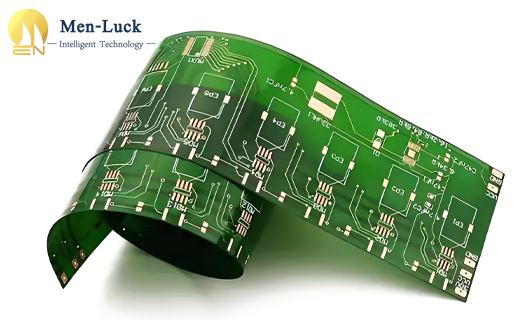
The ultraviolet laser cutting machine uses a 355nm short-wavelength light source, with a focused spot diameter of up to 15μm, and achieves non-destructive cutting of 0.05mm line width on a 25μm thick polyimide (PI) substrate. Compared with mechanical stamping processes, laser processing eliminates burrs and stress deformation, and the roughness of the cut edge is reduced to Ra < 0.8μm, ensuring the integrity of 5G high-frequency signal transmission.
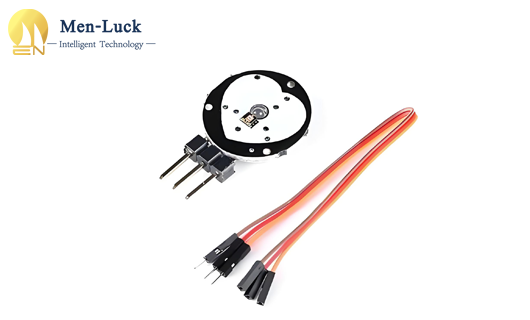
For the heart rate sensor module of smart watches, laser cutting can form a 0.2mm diameter bioelectrode window in one go, accurately exposing the conductive silver paste without damaging the underlying PET film.
Femtosecond laser technology uses the cold processing characteristics of ultrashort pulses (10^-15 seconds) to achieve local interlayer peeling in 8-layer flexible boards, selectively removing designated dielectric layers without affecting adjacent circuits. This technology overcomes the problem of multi-layer FPC rework, reducing maintenance costs by 70%, and is particularly suitable for high-reliability circuit maintenance of aerospace equipment.
Laser equipment with integrated machine vision can automatically identify FPC positioning marks, compensate for material expansion and contraction deformation, and achieve micron-level repeatable positioning accuracy. Laser processing gradually replaces traditional chemical etching processes, reducing hundreds of tons of acid waste liquid emissions each year, while supporting the precision processing of environmentally friendly materials such as PI and LCP.
From consumer electronics to implantable medical devices, laser cutting technology not only solves the manufacturing problems of flexible circuit boards, but also promotes the evolution of electronic products towards lighter, thinner and more reliable directions through process innovation. This technology is becoming the core engine for the upgrading of the flexible electronics industry, continuously expanding the boundaries of interaction between humans and smart devices.
 WhatsApp:
 Wechat
Laser precision cutting machine: the core equipment for semiconductor and communication device manufacturing 2026-08-17
In the field of semiconductor and communication device manufacturing, the limits of accuracy are constantly being rewritten - chip processes are approaching physical limits, 5G base station filter apertures continue to shrink, and tolerances for some key features have entered t…
Metal Laser Cutting Machines for Precision Airbag Generator Components 2026-07-17
In automotive passive safety systems, the airbag generator is a propellant-driven precision device. It contains multiple thin-walled metal components, such as the igniter housing, filter support, and gas diffuser. These components need to withstand extremely high temperatures a…
Laser Cutting Machines: An Efficiency Revolution for Construction Sites and Factory Maintenance 2026-06-26
In construction installation, equipment rental, and factory maintenance, do you often encounter this dilemma: urgently needing a steel beam of a specific size, an irregularly shaped reinforcing plate, or a non-standard flange gasket? Outsourcing processing has long cycles, and …
Femtosecond Laser Precision Cutting: Overcoming the Challenges of Processing Nickel-Titanium Heart Stents 2026-05-19
In the field of interventional cardiology, heart stents are hailed as the "guardians of life's pathways." A nickel-titanium alloy tube—measuring a mere 1.5 millimeters in diameter with a wall thickness of approximately 100 microns—must be processed into a mesh-like structure fe…